Premium Stainless Steel Tubing Coil Product Range
This section introduces top-grade stainless steel tubing coil offerings for industrial buyers across the United States. Our focus covers coil stainless steel tubing and related stick options, catalog metadata such as SKUs and manufacturer part numbers (MPN), and standards compliance to help procurement and engineering teams compare stainless steel tube coil suppliers quickly.
Typical inventories list stainless steel coil tube in 150 ft, 300 ft, and 500 ft coils alongside 10 ft and 20 ft stick tubing. Vendors such as Mako Products list ASTM A269 and ASTM/ASME S/SA249 production notes, whereas Sun Steel and comparable sources cite ASTM A269, ASTM A213, and ASME SA213 when supporting performance claims for premium stainless tubing.
Product pages typically show both grouped and individual SKUs, along with formatted pricing and current inventory information. Details include welded or seamless construction, hot-rolled or cold-rolled finishes, and grade options such as 304, 316, and higher-alloy requests. These attributes make it easier to match coil stainless steel tubing to pressure, corrosion, and handling requirements.
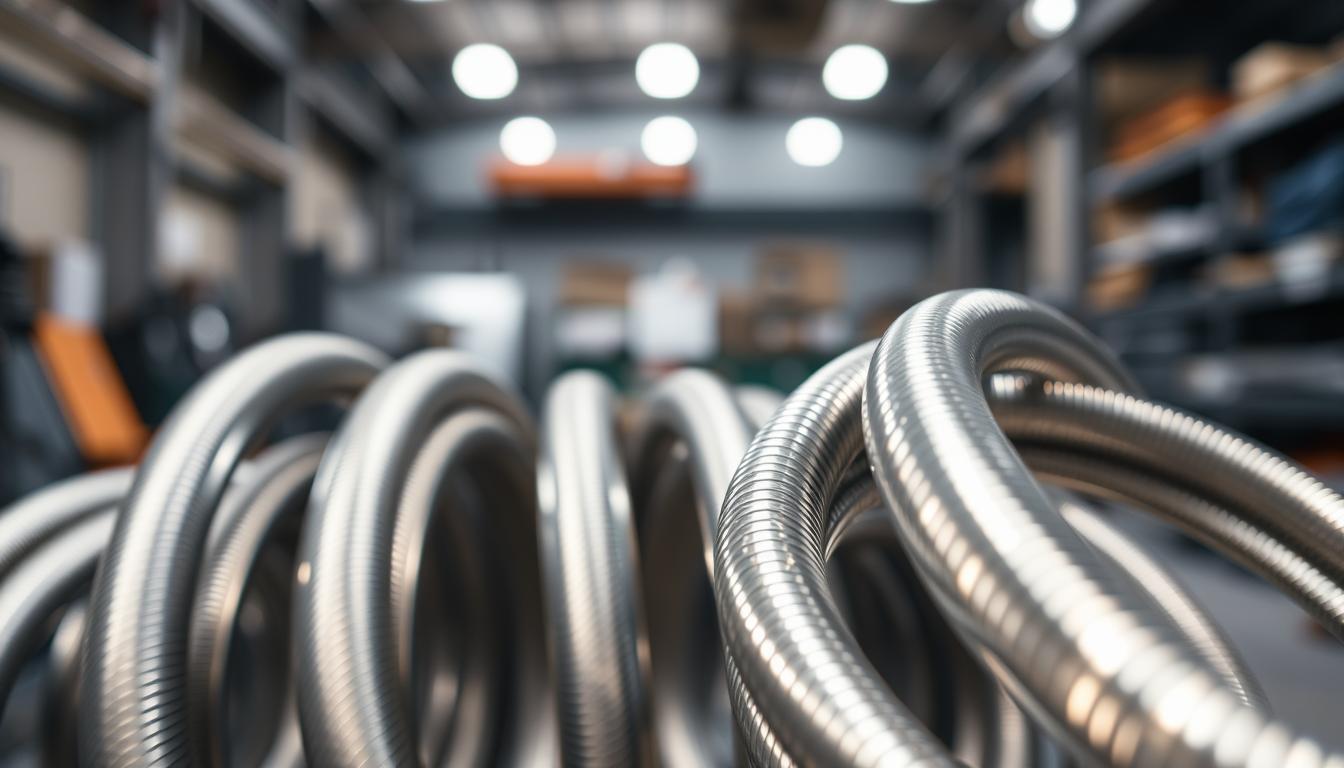
Overview of Stainless Steel Coil Tubing for Industrial Use
Coil stainless steel tubing provides a compact and flexible supply format suitable for continuous-run systems in plant environments and field installations. Because fewer joints and fittings are needed, this configuration reduces labor time and the likelihood of leaks relative to segmented tubing. A stainless steel coil tube additionally offers dependable corrosion resistance and pressure capability for instrumentation runs, hydraulic control lines, and process skids.
Definition and Core Properties
A stainless steel tubing coil is a wound length of tubing manufactured to meet industry standards such as ASTM A269 or ASME SA213. Common properties include high tensile strength, solid fatigue resistance, and strong corrosion performance in oxidizing and many reducing conditions. They are supplied in standard sizes and alloy options that meet instrumentation and hydraulic application requirements.
Key Differences Between Coil and Stick Tubing
Coil format supports long, continuous runs without repeated joints. Installers save time because fewer fittings are required. Stick tubing arrives in fixed lengths, often 10 ft or 20 ft, and needs more connections for the same run. Coils are unspooled to track complex routing, while stick tubing is often better for short, linear sections.
Typical Lengths and Packaging Options (150 ft, 300 ft, 500 ft)
Standard coil offerings commonly include 150 ft, 300 ft, and 500 ft packages, with custom lengths available on request. Suppliers list SKUs and manufacturer part numbers in online catalogs and let buyers filter by diameter, wall, material grade, and length. For projects requiring 3/8 steel tubing, coils reduce handling time and minimize joint count compared with sticks.
Stainless Steel Tubing in Coil Form
Coiled tubing delivers continuous length and flexibility that suit long runs for instrumentation, hydraulic, and process skids. Suppliers such as Mako Products and Parker Hannifin list coil products with specific SKUs, lengths, and handling notes so buyers can match coil stainless steel tubing to system needs.
What makes coiled tubing distinct for continuous-run applications
Coiled product is shipped in long, rolled lengths that significantly reduce the piecewise joins common with stick tubing. Because the length is continuous, fewer couplings are needed and routing around equipment racks becomes simpler. Installers can cut a stainless steel coil tube to exact jobsite lengths, which speeds installation and reduces material waste.
Benefits of coils: fewer fittings, faster installation, reduced leak points
Coiled runs decrease the total number of fittings and unions in a system. With fewer joints, there are fewer potential leak paths and reduced assembly labor.
Field crews regularly see shorter install timelines when stainless steel tubing coil is used instead of stick tubing. This change saves time on alignment, welding, and brazing operations. Where 3/8 id stainless steel tubing is used, many projects see noticeable gains in cleanliness and instrumentation line reliability.
Coil handling, unspooling, and storage best practices
Avoid kinks by unspooling coils from a controlled reel or cradle rather than pulling freely. Pulling at an angle or too quickly causes deformation. Keep coil stainless steel tubing on purpose-built reels to preserve its natural bend radius.
Store coils dry and covered to prevent contamination and surface staining. Label each coil with material certificates, SKU, and batch details so traceability is immediate for quality checks.
- Unspool with a guided reel at low speed and keep bends above the specified minimum bend radius.
- Use padded supports or racks so the stainless steel coil tube does not deform under weight.
- Seal the ends with caps to stop debris from entering before final connections are made.
- Ask for supplier handling guides and mill test reports whenever you order coil stainless steel tubing.
Material Grades: 304, 316 and Duplex Options
Selecting the correct alloy directly affects performance, cost, and service life for a stainless steel coil tube. In practice, engineers consider corrosion resistance, mechanical strength, and workability when pairing a grade with its application. Supplier catalogs frequently encode grade within the SKU or MPN, making it easier for buyers to choose 304 stainless steel tubing, 316 stainless steel tubing, or duplex stainless steel coil for specific projects.
304 Stainless Steel: Properties, Common Uses, and Cost Points
304 stainless steel tubing remains relatively economical and simple to form. Because the alloy is malleable and welds readily, it sees frequent use in machine parts, HVAC runs, and food processing systems. General corrosion resistance is solid in most environments, although continuous saltwater service is not a strong point. If budget and ease of fabrication outweigh chloride resistance needs, 304 stainless steel is a sensible selection.
316 stainless steel: molybdenum content and marine-grade corrosion resistance
Molybdenum in 316 stainless steel tubing greatly improves chloride and pitting resistance. This characteristic makes 316 a go-to grade for marine systems, offshore platforms, and surgical equipment. Projects exposed to brackish water or aggressive chemicals benefit from the longer service life and lower maintenance that 316 delivers compared with 304.
Duplex stainless steels: increased strength and pitting resistance for harsh environments
Duplex stainless steel coil combines austenitic and ferritic phases to deliver higher yield strength and better pitting resistance. Such properties make duplex a strong fit for deepwater, chemical processing, and high-stress piping where loads and corrosion are severe. Duplex is costlier up front but can reduce downtime and replacement frequency in demanding conditions.
Grade selection depends on temperature, mechanical load, and the specific corrosive agents the tubing faces. For continuous-run systems where long coils are used, match mechanical needs and corrosion profile to decide between 304 stainless steel tubing, 316 stainless steel tubing, or a duplex stainless steel coil. An appropriate stainless steel coil tube selection minimizes fittings, reduces leak potential, and improves lifecycle cost performance.
Seamless vs. Welded Coil Tubing
Manufacturers typically rely on two primary routes to produce tubing. In one method, welded stainless steel tubing is formed by rolling a strip and welding the longitudinal seam. The other route yields seamless stainless steel coil via extrusion or piercing of a solid billet followed by drawing through dies. These methods differ in cost, strength profile, and appropriate application range.
Manufacturing Contrasts and Appropriate Uses
Welded stainless steel tubing is typically more economical and suits general instrumentation, HVAC, and low- to moderate-pressure lines. The welding seam is fused and inspected to meet quality standards listed on product pages and mill test reports.
Seamless stainless steel coil is free of a weld seam and exhibits improved uniformity when stressed. As a result, seamless coils are often used in deep oil and gas control lines, high-pressure hydraulic systems, and critical process services where reliability is paramount.
Comparing Pressure, Corrosion, and Reliability Performance
Seamless tubing generally delivers roughly a 20% higher working pressure for the same size and alloy when compared to welded alternatives. Buyers choose seamless tubing when peak burst margin and fatigue resistance are priorities.
For many industrial duties, welded stainless steel tubing provides adequate performance at a lower cost. When properly fabricated and inspected, welded tube can achieve long service life in corrosive environments, provided the correct alloy and post-weld treatments are chosen.
Which Standards to Confirm on Specs and Mill Test Reports
Buyers should always verify applicable standards on specification sheets and mill test reports. Typical references are ASTM A269 covering drawn or cold-finished seamless and welded tubing, ASTM A213 for seamless boiler and superheater tubes, and ASME SA213 as the code-equivalent listing.
| Feature | Seamless Stainless Steel Coil | Welded Stainless Steel Tube |
|---|---|---|
| Manufacturing | Pierced or extruded from billet and then drawn | Rolled from strip and welded longitudinally |
| Cost Level | Higher per foot | Lower per foot |
| Working pressure | Typically around 20% higher than welded | Lower for same size/material |
| Typical Applications | High-pressure oil & gas, critical hydraulics | Instrumentation, general process lines, and HVAC |
| Standards referenced | ASTM A213, ASME SA213, ASTM A269 where applicable | ASTM A269 for cold-finished welded, vendor-specific MTRs |
| Inspection Focus Areas | Dimensional accuracy, hydrostatic, tensile | Weld integrity, nondestructive examinations, and hydrostatic tests |
Pressure Ratings, Wall Thickness, and 3/8 Tubing Steel Considerations
Matching wall thickness and diameter to working pressure is a practical step for engineers and buyers. Pressure ratings depend on material grade, wall thickness, and tube diameter. Thicker walls increase pressure resistance, and seamless construction usually provides higher ratings than welded equivalents. Catalog specs and manufacturer part numbers provide exact values for each SKU.
How Wall Thickness and Diameter Affect Working Pressure
For any specific alloy, thinner walls decrease burst pressure and shorten fatigue life. Outer diameter and inner diameter establish the stress distribution under internal pressure. Consult published charts for the chosen grade when comparing working pressure at various wall thicknesses. When higher cyclic loads are present, select a heavier wall or a duplex grade to reduce the risk of crack initiation.
Choosing 3/8 Tubing Steel or 3/8 ID Stainless Steel Tubing for Hydraulic and Instrumentation Lines
Three-eighths-inch tubing dimensions are common in instrumentation and light hydraulic lines. Buyers may specify 3/8 tubing steel on an OD basis or request 3/8 id stainless steel tubing when exact internal flow or fittings compatibility is critical. Vendors such as Mako Products offer these dimensions in both stick and coil styles, with stainless steel tubing coil suited for long continuous runs.
Calculating safe operating pressure and safety factors
Start with the manufacturer pressure chart for the chosen grade and wall. Then apply a safety factor consistent with governing codes and the risk profile of the application. Typical safety factors may range from about 1.5 for noncritical instrumentation up to 4 for high-risk hydraulic systems. When lines face dynamic loading or fatigue concerns, lower the allowable working pressure or choose a thicker-walled seamless tube.
Practical checklist for selection includes:
- Confirm OD, ID, and wall thickness using the specification sheet.
- Compare rated working pressure for welded versus seamless construction.
- Choose between OD-based 3/8 steel tubing and 3/8 id stainless steel tubing according to fittings and flow requirements.
- Choose stainless steel tubing coil when long continuous lengths lower fittings count and leak points.
- Document safety factor and reference the manufacturer’s pressure chart in procurement records.
How Surface Finishes and Processes Affect Tubing Performance
The manufacturing path chosen will affect surface quality, mechanical strength, and overall tubing cost. A hot-rolled stainless steel coil is made above recrystallization temperature. This process accelerates production and results in good ductility for bending and forming operations. However, the surface is typically rougher and may need additional grinding or polishing for visible or sanitary service.
Cold-rolled stainless steel tubing is processed by rolling the metal at room temperature. This cold working tightens dimensional tolerances and enhances tensile strength. A smoother, brighter finish emerges, ideal for medical, aerospace, and fine instrumentation uses. Product pages often present both hot-rolled and cold-rolled stainless steel coil tube variants so buyers can compare finishes.
Hot-Rolled vs. Cold-Rolled: Surface and Mechanical Comparison
| Key Attribute | Hot-rolled stainless steel coil | Cold-Rolled Stainless Steel Tubing |
|---|---|---|
| Surface Appearance | Matte, mill scale present, needs finishing | Bright, smooth surface with low roughness |
| Mechanical properties | Higher ductility but lower tensile strength | Higher tensile strength and improved yield strength |
| Dimensional Tolerances | Wider dimensional tolerances | Tighter dimensional tolerances |
| Common Uses | General fabrication, heavy duty tubing | Instrumentation, medical, aerospace tubing |
| Cost | Usually lower cost per foot | Higher due to extra processing |
| Example product type | Stainless steel tubing coil for HVAC and structural runs | Stainless steel coil tube for catheter housings and sensors |
For thin-wall tubing, finish choices become especially important when leak risk or contamination is critical. Using polished or bright finishes lowers the potential for particle trapping. Through electropolishing and mechanical polishing, a passive, low-roughness surface is created that suits stainless steel tubing coil in clean-room service.
Common post-processing steps include pickling, passivation, electropolishing, and ultrasonic cleaning. With pickling, scale and weld discoloration are removed from the surface. By passivating, the chromium-rich oxide film is strengthened, improving corrosion resistance. Electropolishing smooths microscopic peaks, reducing bacterial adhesion and improving flow within a stainless steel coil tube.
Razor tubing and related specialty products are supplied in both welded and seamless versions. The decision depends on strength needs and finish targets. For instrumentation or medical lines, cold-rolled tubing with tight surface tolerances is recommended, and buyers should confirm whether the supplier provides cleaning and passivation for a ready-to-install stainless steel tubing coil.
When specifying finish, include measurable targets: surface roughness (Ra), visible inspection level, and passivation method. Clear specs speed procurement and reduce rework when a stainless steel coil tube must meet sterile or high-purity standards.
Industrial Applications Where Coil Stainless Steel Tubing Excels
Coiled stainless steel products serve many industries where continuous length, corrosion resistance, and pressure performance matter. Choosing the right grade and construction for each use case reduces downtime and meets regulatory needs. Below is a concise overview of typical applications and the tubing types that suit them.
Oil & gas uses
Coiled tubing is used by operators for control lines, hydraulic circuits, and downhole services because a stainless steel tubing coil enables long runs with relatively few fittings. Higher pressure demands in completions and hydraulic pumping are often met with seamless coil stainless steel tubing. Mako Products and other suppliers list marine and offshore-rated 316 options for corrosive sea environments.
Chemical Processing and Corrosive Media
In chemical plants, stainless steel coil tube is widely used for feed lines, sampling, and moving aggressive fluids. Selecting 316 or duplex grades helps resist pitting and chloride stress. When the stainless steel coil is well-matched to the medium, it lowers leak potential and eases maintenance under corrosive conditions.
Medical, pharmaceutical, aerospace, instrumentation, and heat exchangers
Medical and pharmaceutical systems demand high-purity finishes and tight dimensional tolerances. Polished, cold-rolled coil stainless steel tubing together with precise 3/8 id stainless steel tubing are commonly used for sterile fluid transfer and instrumentation lines. In aerospace, corrosion-resistant and high-strength tubing is applied in fuel and hydraulic circuits. For instrumentation and heat exchangers, consistent wall thickness and clean internal surfaces in a stainless steel tubing coil help maintain controlled flow and thermal performance.
At-a-Glance Comparison for Buyers
| Industry | Recommended Construction | Typical Grade | Why Coil Tubing Works |
|---|---|---|---|
| Oil & Gas | Seamless coiled tubing constructions | 316, duplex | Continuous runs with high pressure capability and fewer fittings |
| Chemical Processing Plants | Coil or stick tubing, typically passivated | 316 and duplex alloys | Corrosion resistance, reduced contamination |
| Medical & Pharma | Cold-rolled, polished coil stainless steel tubing products | 304L, 316L | High purity, straightforward cleaning, and regulatory compliance |
| Aerospace Applications | High-strength seamless coil | Duplex or specialty high-strength alloys | Weight savings, pressure and fatigue resistance |
| Instrumentation and Heat Exchangers | Precision stainless steel tubing coil | 304 or 316 grades | Stable dimensions, accurate flow control |
When specifying coil stainless steel tubing, be sure to ask suppliers about traceability, mill test reports, and finish recommendations. Small details such as inside diameter tolerance for 3/8 id stainless steel tubing and proper spool handling determine long-term reliability in demanding services.
Guidance on Sizing and Specifying Coil Stainless Steel Tubing
Purchasing coil stainless steel tubing works best with a clear plan in place. First document system needs related to flow, pressure, temperature, and chemical exposure. Rely on manufacturer part numbers and SKUs to verify material grade and test reports before placing an order.
Selecting inner diameter vs. outer diameter requirements
Use ID-based sizing where internal flow performance and fitting compatibility are critical. Inner diameter governs fluid velocity and pressure drop in lines such as instrumentation or hydraulic control circuits.
Choose OD-based sizing if fittings clamp around the tube or bundle spacing and routing clearances are key. Bend radius and support hardware clearance are strongly influenced by outer diameter.
Aligning Tubing Specifications With Flow, Pressure, and Compatibility Needs
Match wall thickness and material grade to the expected working pressure profile. Thicker walls increase allowable pressure but slightly reduce flow area.
Also consider mechanical loads, temperature variations, and corrosive media. Grades like 304 and 316 differ in corrosion resistance. In aggressive environments, duplex grades provide higher strength.
In most catalogs, 150 ft, 300 ft, and 500 ft coil stainless steel tubing is listed alongside 10 ft and 20 ft cut sticks. Decide between continuous coil use and stick segments based on installation speed and leak-point reduction.
How to Read Manufacturer Part Numbers, SKUs, and Spec Sheets
Part numbers often encode diameter, wall thickness, and material. SKUs shown on product pages correspond to MPNs on mill test reports. Always request the MTR and confirm applicable standards such as ASTM A269 or ASME SA213.
Use spec sheet fields to check OD, ID, wall thickness, finish, and pressure rating. Cross-reference a 3/8 steel tubing entry with its MTR to verify tensile strength and hardness. Look for listings that explicitly state 3/8 tubing steel when that size is required.
| Spec Field | What to check | Why it matters |
|---|---|---|
| Part Number / SKU | Decode for OD, wall, grade | Ensures correct size selection and traceability to the mill test report |
| Outer Diameter (OD) | Match tubing OD with fittings and clamp hardware | Affects bend radius and clearance in assemblies |
| Inner Diameter (ID) | Used for flow and pressure drop calculations | Influences velocity, metering, and instrumentation accuracy |
| Wall thickness | Compare against working pressure and safety factors | Controls pressure rating and mechanical strength |
| Material grade | 304, 316, Duplex, etc. | Sets corrosion resistance and temperature limits |
| Standards Referenced | ASTM and ASME listings on the spec sheet | Confirms manufacturing practices and testing benchmarks |
| Length options | Coil vs. stick (150/300/500 ft coils, 10/20 ft sticks) | Influences installation time, fittings count, and waste |
| Test Documents | Mill Test Report, hydrostatic tests | Validates material chemistry, tensile, and pressure performance |
When comparing quotes, request clarification from suppliers for any unclear SKU components. Confirm if each listed item is a stainless steel tubing coil or a cut-to-length stick. For 3/8 steel tubing, insist that MTRs match the part number so there are no surprises during installation.
Quality, Certification, and Testing Considerations
Buyers should confirm material standards and test records before accepting a stainless steel tubing coil shipment. Clear documentation speeds approval processes for regulated systems and supports long-term traceability.
Relevant standards set composition, tensile limits, and corrosion criteria for coiled and straight products. Common references include ASTM A269, ASTM A213, and ASME SA213, which cover seamless and welded tubing used in process, power, and HVAC systems.
Key Laboratory and Factory Tests
- Tensile tests that confirm yield and ultimate strength against the specified values.
- Hydrostatic testing to confirm pressure integrity for each coil or lot.
- Corrosion and pitting tests to evaluate resistance in the intended service environments.
Traceability and Mill Documentation
Mill test reports (MTRs) should list heat numbers, chemical analysis, and mechanical results for each coil or cut length. Requesting MTRs helps link each stainless steel coil tube back to its production batch for warranty and safety audits.
Verifying Supplier Claims
Standards like ASTM A269 and ASTM A213 are often listed on product pages and catalogs, sometimes with MTRs attached. Trusted suppliers clarify if their products carry ASME SA213 certification and can furnish third-party lab reports when requested.
Acceptance Testing on Delivery
- Inspect coil packaging and verify that heat number stamping is consistent.
- Ensure mill certificates correspond to physical markings prior to using coils in production.
- Keep hydrostatic and tensile records with project quality files.
Maintaining clear records for each stainless steel tubing coil improves compliance and reduces risk during commissioning. When choosing a vendor, verify that test methods and certifications meet project specifications for full acceptance into service.
Choosing Suppliers and Inventory Options in the U.S.
Vendor selection has a direct impact on project schedule, cost, and long-term system performance. Domestic suppliers often keep ready stock and offer faster turnaround. Import sources may reduce material cost but typically add lead time and require additional inspection. When ordering a stainless steel tubing coil or sticks, buyers must weigh delivery speed versus pricing and quality assurance.
Ask about standard inventory lengths up front. Many U.S. distributors list 150 ft, 300 ft, and 500 ft coils alongside 10 ft and 20 ft stick options. A clear inventory table speeds procurement and avoids production delays. Also verify whether coil stainless steel tubing is available in hot-rolled or cold-rolled finishes suitable for your use.
Request cut-to-length services when you need specific sizes. Custom cuts help reduce waste on-site and speed assembly for instrumentation work involving 3/8 id stainless steel tubing. Verify minimum order quantities, turnaround times, and any trimming and deburring fees.
Review each supplier’s documentation and warranty practices. Trusted vendors provide mill test reports, material certificates, and traceability for both coil stainless steel tubing and 3/8 steel tubing. Clarify how warranties handle custom-cut pieces and coils that have been partially unspooled for inspection.
Technical support matters when sizing or matching alloys. Suppliers such as Mako Products and Sun Steel maintain product catalogs with SKUs, spec filters, and technical staff who advise on compatibility with ASTM A269 and ASME standards. Confirm that supplier engineers can assist with selecting 3/8 steel tubing for hydraulic runs or 3/8 id stainless steel tubing for instrumentation lines.
Negotiate service terms before you issue any purchase orders. Key points include lead time guarantees, packaging methods to protect coil stainless steel tubing in transit, return policies, and inspection windows on delivery. Clear terms help reduce disputes and expedite project acceptance.
| Item Type | Common Options Offered | Lead Time Typical | Notes |
|---|---|---|---|
| Coil Lengths | 150 ft, 300 ft, and 500 ft | In-stock: about 1–7 business days; Import: roughly 4–12+ weeks | Check finish (hot-rolled or cold-rolled) and request MTRs |
| Stick Lengths | 10 ft and 20 ft | In-stock: 1–5 business days | Good for standard installs and tight turnaround |
| Custom Cuts | Cut-to-length, deburred, packaged | 1–10 business days depending on qty | Reduces field labor; verify minimums and fees |
| Alloy and Grade Options | 304, 316, and duplex | In-stock grades: faster; special alloys: longer | Confirm standards: ASTM A269, ASME S/SA249 |
| Documentation Provided | MTRs, certifications, traceability | Provided with shipment or made available on request | Essential for regulated and safety-critical work |
Before finalizing a supplier, create a short checklist for quotes. That checklist should cover available stainless steel tubing coil sizes, prices for coil stainless steel tubing and 3/8 steel tubing, fees for custom 3/8 id stainless steel tubing cuts, warranty conditions, and technical contact details. Using this list simplifies supplier comparisons and helps keep projects on schedule.
Cost Factors, Lead Times, and Value Considerations
Price visibility for stainless steel tubing coil can vary significantly between suppliers. Online listings often combine “call for price” items with visible prices, bundled SKUs, and volume-based discounts. As a result, comparing coil stainless steel tubing offers is challenging unless you request a full quote detailing unit cost, bundle logic, and shipping or handling fees.
Material grade, construction method, and length are primary cost drivers. 304 is usually less expensive than 316 or duplex, and seamless tubing carries a premium over welded due to higher working pressure and reliability. Longer coil lengths (150 ft, 300 ft, 500 ft) and value-add services including custom cutting, passivation, or polishing add to cost, particularly for medical- or aerospace-quality cold-rolled or polished finishes.
Testing, certification, and sourcing affect both cost and lead time. Mill test reports, hydrostatic testing, and traceability documentation add procurement expense but are essential for regulated industries. Domestic supply often reduces lead time and logistics risk, while import coil stainless steel tubing can lower unit price but increase wait times. Consider how performance requirements for 3/8 tubing steel or 3/8 steel tubing shape supplier selection and inventory plans.
Evaluate total lifecycle value rather than unit price alone. Faster installation, reduced fittings, and lower leak risk from coiled runs can offset higher material prices. By asking for formal quotes detailing material grade, welded or seamless construction, finish, testing, and committed lead times, you can compare real value across suppliers and make a cost-optimized decision for your project.